
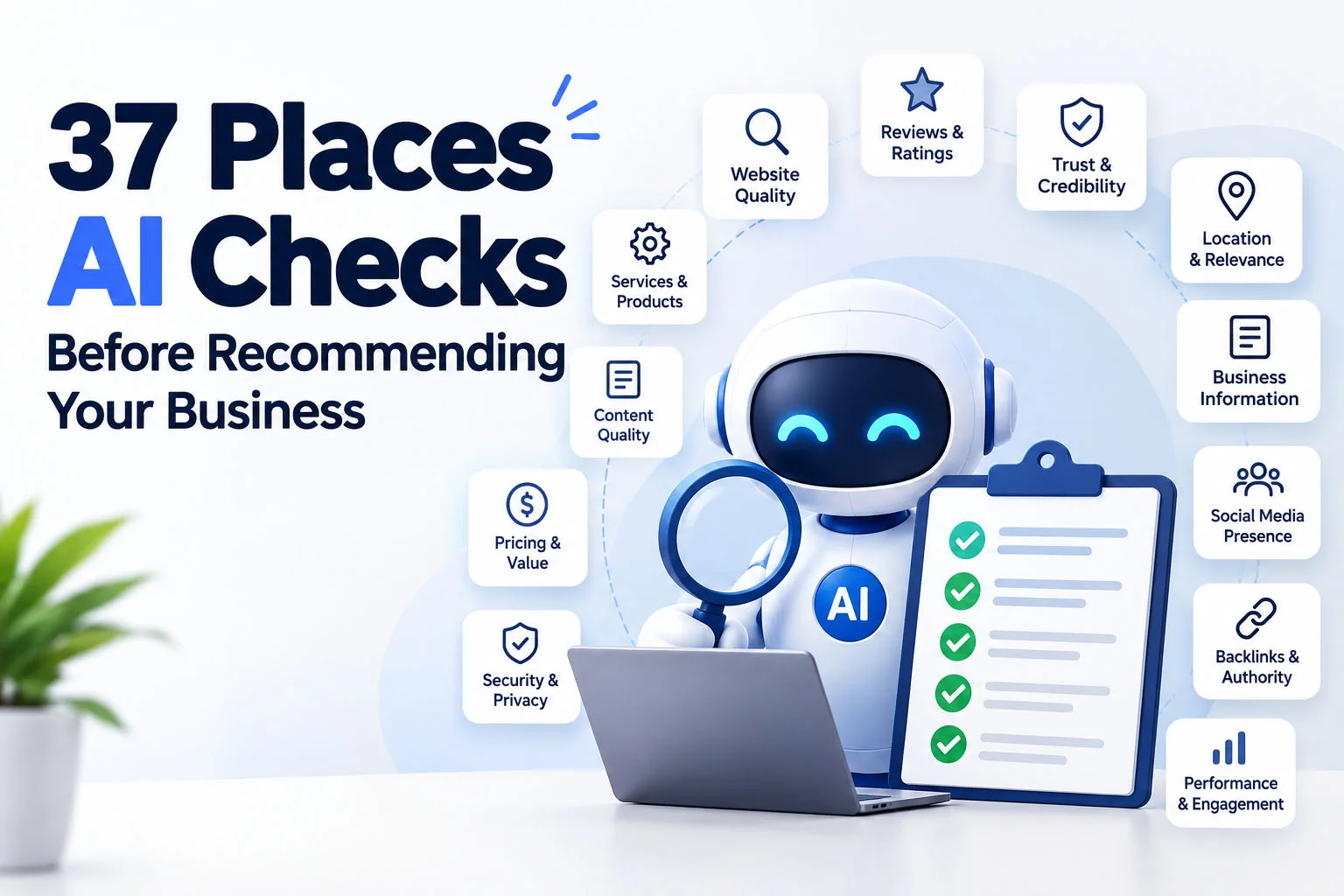
Ask ChatGPT for a garage door company in Vaughan and it doesn’t guess. It reads. In a few seconds it pulls your website, your Google reviews, a Reddit thread from three years ago, and a “best in Vaughan” article you never knew existed, then decides whether you make the shortlist.
Most of the business owners we sit down with in the GTA have worked hard on one or two of those sources. Almost none have looked at all of them. So here is the full list of 37, grouped by how the AI actually uses them, with a note on which ones are worth your time if you’re a local service business in Ontario.
The core five: this is 80% of it
If an AI model only had five sources to look at, it would be these. For a home-service or trades business, they carry most of the weight.
- 1. Your website. The model reads it like a customer would, only faster. Vague service pages (“we do it all across the GTA”) give it nothing to quote. Pages that say what you do, in which city, with real project detail, get lifted straight into the answer.
- 2. Google Business Profile. Categories, hours, services, photos, Q&A. If your primary category is wrong, you’re invisible for that query no matter how good the website is.
- 3. Google Reviews. Not just the star rating. AI reads the text. Fifty reviews that say “great service” tell it less than ten that mention the actual job, the crew, and the street.
- 4. Google Maps. Your pin, your service area, your proximity to the person asking. This is where “near me” gets decided.
- 5. Facebook page. Still the second most-checked business profile in Canada after Google. An empty page with a 2019 cover photo reads as a business that may not be operating.
Your own channels: what you publish
These are the places you control. They matter because they give the model long-form text in your own words, which is what it needs to describe what you do.
- 6. Instagram and 7. LinkedIn company page. Consistency matters more than volume. Same name, same phone, same service list as everywhere else.
- 8. YouTube channel and 9. YouTube transcripts. This one surprises people. AI models read the auto-generated captions of your videos. A five-minute walkthrough of a window install in Mississauga becomes a thousand words of expert content the model can cite.
- 16. Your podcast transcripts and 36. Podcasts you guest on. Same idea. If you’ve spoken for 40 minutes about propane delivery or dental implants, that transcript exists somewhere, and it’s being read.
Review and trust platforms
The model cross-checks your Google reviews against everything else. Big gaps between platforms (4.9 on Google, 2.1 on BBB) make it cautious.
- 10. Yelp. Weaker in Canada than the US, but models trained on US data still weight it.
- 11. Trustpilot and 12. TripAdvisor. Mostly for e-commerce and hospitality. A roofer can skip TripAdvisor.
- 13. Better Business Bureau. Still checked often for contractors, movers, and anything with a deposit involved. An unanswered complaint sits there for years.
- 31. Angi and 32. Thumbtack. US-heavy, but they show up in Canadian AI answers for home services because the models don’t always separate the two markets cleanly.
- 25. G2, 26. Capterra, 27. Clutch. Software and agencies only. If you sell a product or service to other businesses, these matter. If you install fences, they don’t.
The other maps
- 14. Apple Maps. Every iPhone user asking Siri. Most small businesses have never claimed their Apple listing, so the data is pulled from Yelp and often wrong.
- 15. Bing Places. ChatGPT’s web search runs on Bing. That alone makes Bing Places worth the 20 minutes it takes to claim and sync.
Where people talk about you when you’re not in the room
This group is the one owners underestimate. The model treats an unprompted mention by a stranger as more credible than anything on your own site.
- 18. Reddit threads. r/askTO, r/Mississauga, r/PersonalFinanceCanada. A recommendation (or a warning) in one of these threads is weighted heavily because it’s unpaid and specific.
- 19. Quora answers and 22. Stack Exchange. Less relevant for local trades, more for professional services and technical products.
- 20. Facebook (groups and posts, separate from your page) and 21. Nextdoor. Neighbourhood groups are where “anyone know a good plumber in Oakville?” gets asked and answered. AI reads the public ones.
- 24. Industry forums. RedFlagDeals, contractor forums, dental and legal community boards. Niche, but the mentions there are almost always detailed.
- 23. Product Hunt. Software launches only.
Company and employer records
- 28. Glassdoor and 30. Indeed. The model uses these to judge whether you’re a real, operating company with staff. Reviews from employees also leak into how it describes your service.
- 29. Crunchbase. Funding, founding date, headcount. Mostly for tech companies, but a listing helps confirm you exist.
- 17. Wikipedia and 37. Wikidata. You almost certainly don’t qualify for a Wikipedia page, and trying to create one gets it deleted. Wikidata is different: it’s a structured database that models lean on to confirm your business name, location, and website are the same entity. Worth looking into if you’ve been around long enough to have press coverage.
Third-party coverage
- 33. News articles and 34. Trade publications. A mention in the Toronto Star, a local news site, or an industry magazine is treated as verification. It doesn’t have to be a feature. A quote in someone else’s article counts.
- 35. “Best in your city” listicles. This is the one we see move the needle fastest. When someone asks an AI for the best movers in Burlington, it pulls from existing “top 10 movers in Burlington” articles and cross-references them. If you’re on three of those lists, you’re in the answer. If you’re on none, you’re not, regardless of how good you are.
Two clients who saw it happen
Veni runs Spiros Aluminum & Roofing (spirosaluminumandroofing.ca). A few weeks into his SEO campaign with us, a customer called and told him they’d found the company through ChatGPT. Nobody had told the customer to look there. That was the first time Veni had heard of a lead coming from an AI tool, and it came from getting the core five consistent and putting real job detail on the site.
Jeff and Chloe at Appleby Moving & Storage (applebymoving.com) work Burlington, Oakville, and Hamilton. When we asked Google Gemini for movers in those markets, Appleby came back as the third recommendation. They didn’t get there by being the biggest mover in Halton. They got there because their business facts match across Google, BBB, and their site, and their reviews describe actual moves.
What to actually do with this
You don’t need all 37. A Toronto-area service business that gets the following right will show up in AI answers ahead of competitors who have been around longer.
- Fix the core five first. Same business name, address, and phone across every one of them, matching your Google Business Profile exactly.
- Claim Bing Places and Apple Maps. Both take under half an hour and almost nobody in your market has done it.
- Rewrite your service pages so each one names a specific city and describes real work. AI quotes specifics. It skips generic.
- Get on the “best in [your city]” lists. Some are pay-to-play, some are editorial, and some are worth writing yourself if you have a blog and can be honest about the competition.
- Ask your next ten customers for a review that mentions the job and the town, not just “great service.”
- Search Reddit and Facebook groups for your business name and your competitors’. Read what’s there. Reply where it makes sense.
Then check your own visibility. Open ChatGPT, Gemini, and Google’s AI Mode and ask for your service in your city. If you’re not in the answer, you now know where it looked.
FAQ
How does ChatGPT decide which local businesses to recommend?
It combines what it learned in training with a live web search (through Bing, in ChatGPT’s case) and reads the sources above in real time. Businesses with consistent information across many sources, detailed reviews, and third-party mentions get recommended. Businesses that only exist on their own website usually don’t.
Do I need to be on all 37 of these?
No. For a local service business in Ontario, roughly a dozen carry real weight: your website, Google Business Profile, reviews, Maps, Facebook, Bing Places, Apple Maps, BBB, Reddit, local Facebook groups, news coverage, and “best in your city” lists. Software and B2B companies should add G2, Capterra, Clutch, and Crunchbase.
What’s the fastest way to show up in AI search results?
Fix inconsistent business information first, then get listed in existing “best in [city]” articles. Consistency removes the reason for the model to doubt you. The listicles give it a third party vouching for you. Most businesses see movement within a couple of months of doing both.
Is AI search visibility different from regular SEO?
It overlaps but it isn’t the same. Traditional SEO gets your page ranked. AI search visibility (often called AEO or GEO) gets your business named in the answer itself, which pulls from far more sources than Google’s ten blue links. Good SEO is the foundation. The rest is reputation spread across the places on this list.
Want to know where AI is looking for you right now?
Revup365 Inc. runs an AI visibility check for small businesses across the GTA and Ontario. We ask the major AI tools about your service in your city, show you the answer, and tell you which of these 37 sources is holding you back.
Call 647-612-1640, email info@revup365.com, or visit revup365.com.